The Great Chalk Way
 |  |  |  |
|---|---|---|---|
 |  |  |  |
 |  |  |  |
The Great Chalk Way
The Great Chalk Way (GCW) is a family of established walking and riding routes linking the Dorset and Norfolk Coasts across central southern England following an ancient trading route along chalk ridges. It forms a coast to coast route of getting on for 400 miles. The six trails that comprise the GCW are -
-
Wessex Ridgeway
-
Cranborne Droves Way
-
Sarsen Way
-
The Ridgeway
-
Icknield Way
-
Peddars Way
The GCW starts at Lyme Regis in Dorset and finishes at Holme-next-the-Sea in Norfolk. It's also referred to as the 'Greater Ridgeway' and the 'Icknield Way'. It was officially launched by the Friends of the Ridgeway in conjunction with the Icknield Way Association as the 'Great Chalk Way' in October 2024, although the idea of it was first mooted back in 2007. Taken as one trail it would be England's 5th longest trail.

The Friends of the Ridgeway is a voluntary organisation set up in 1983 with a primary aim to preserve and maintain the special nature of The Ridgeway National Trail, mainly in response to its abuse west of the Thames by off-road vehicles. In 2009 the Friends of the Ridgeway’s constitution was changed to apply its principal objective to any extension of the ancient Ridgeway trackways along the chalk downs of southern England. As a result, the Friends of the Ridgeway was determined to create a coast to coast trail from the Dorset Coast to The Wash. It was decided to name the new trail the Great Chalk Way.
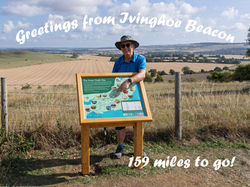
As each component trail already had its own distinctive waymarker, there was no need to create one for the route as a whole. However, to promote the GCW and advertise its existence to the walking public, it was agreed that information boards should be placed at the start and finish of each component trail, showing the route of the GCW and giving pictorial and factual information about it.

Sadly, the Friends of the Ridgeway was not able to get permission from Norfolk Council to install one at Holme-next-the-Sea. Similarly, at Win Green the National Trust would not allow a board. As of May 2026 I believe there are 9 GCW information boards as my photos below show. I find it particularly upsetting that there isn't one at Holme-next-the-Sea because if you've walked getting on for 400 miles along England's 5th longest trail, there is nothing there to suggest what you've actually achieved; maybe one day, even if the board has to be erected at Hunstanton which is normally regarded as the final destination, being the nearest transportation hub?
As a personal challenge for 2025 I planned to walk the entire trail, setting off from Lyme Regis at the end of April 2025. As I live in Northamptonshire I'd have to stay overnight in pubs and hotels along the way. I decided I would initially do a week at a time before coming home for a few days. All being well I'd complete my challenge before the end of summer. The distance wouldn't daunt me but as the area covered by the Wessex Ridgeway in particular is quite remote in places, I'd really have to get my planning right. Thankfully, I really enjoy sorting out logistics for trails like the GCW!
Looking at the very high-level map of the trail you’ll see that the Wessex Ridgeway (in light blue) meets The Ridgeway (in dark blue) near the World Heritage Site of Avebury in Wiltshire. However, there is an alternative route that peels off to the right at Win Green, continues to Salisbury on the Cranborne Droves Way (in yellow) and then continues towards Avebury on the Sarsen Way (in orange). It’s clear just by looking at the map that this alternative route is shorter than just continuing on the Wessex Ridgeway; it also looks more interesting to me as it takes in the city of Salisbury as well as passing close to Stonehenge.

For these reasons I chose to walk the alternative route via Salisbury. In fact, the Cranborne Droves Way and Sarsen Way were created in order to make a more authentic upland route along chalk ridges, to and through Salisbury than the northern section of the Wessex Ridgeway offers. However, for the sake of completeness I decided that at some point in the future I would have to walk the remaining 73 miles of the Wessex Ridgeway from Win Green to Avebury and on to its finish in Marlborough. I therefore completed what I have called the 'Wessex Ridgeway - Wiltshire Section' during April and May 2026. I have to say I found the Wiltshire section incredibly interesting and enjoyable.
The Trails
The images and videos in my blogs are best viewed on desktop, laptop or tablet.


Facts & Figures
-
I completed the GCW in 27 stages between the end of April 2025 and early September 2025 with June and July spent walking the Thames Path
-
Official distance - source OS Maps - 362 miles
-
Total ascent - 28244 feet
-
Total descent - 28237 feet
-
Highest point - 910 feet
-
Longest stage - 23 miles - Peddars Way - Castle Acre to Hunstanton via Holme-next-the-Sea
-
Favourite stage - A tie between the Sarsen Way from Upavon to Overton Hill (to include Avebury) and The Ridgeway from Princes Risborough to Ivinghoe Beacon
-
I additionally walked the Wiltshire section of the Wessex Ridgeway during April and May 2026 in 7 stages. The official distance for Win Green to Marlborough is about 73 miles.
-
During the course of the walk I passed through 11 counties - Dorset, Wiltshire, Berkshire, Oxfordshire, Buckinghamshire, Bedfordshire, Hertfordshire, Essex, Cambridgeshire, Suffolk and Norfolk
-
Hillforts passed - at least 18!
-
Barrows passed - loads!
-
Rain - not one drop!
-
Total expenditure including hotels, food, drink, buses, trains, car parks and petrol - about £3000. Sounds a lot but I love my home comforts too much and don't do camping. I had to spend a number of additional nights to get myself in place ready for early morning starts. If you look at it as a 1 month all-inclusive holiday in the UK in the most glorious weather, I hope you'll agree it was great value for money
-
Cooked breakfasts - at least 20 I'm ashamed to admit - but I was on holiday!
-
Enjoyment - priceless and unforgettable!
 |  |  |
|---|---|---|
 |  |  |
 |  |  |
 |  |