Wessex Ridgeway - Imberbus Day - August 15th 2026


What's it all about?
When I walked the Wiltshire section of the Wessex Ridgeway in April and May 2026 I was introduced to Imber Range Perimeter Path (IRPP). IRPP more or less does what it says on the tin; it’s a 30 mile, mixed surface circular trail on Salisbury Plain around the Imber Range military training area. Here and there, the Wessex Ridgeway and IRPP share the same path, mainly on the western and northern perimeters of the IRPP. The land within IRPP is normally off limits to the public for obvious reasons.

Pretty much in the middle of IRPP is the now-uninhabited village of Imber. The entire civilian population was evicted with 47 days’ notice at the end of 1943 to provide an exercise area for American troops preparing for the invasion of Europe during the WWII. Despite being promised verbally at the time, after the war, villagers were not allowed to return to their homes and the village remains under the control of the MOD.

Nearly all the properties in the village have been demolished over the years. St Giles Church is the only building that is still used on certain days of the year. A few more have been patched up as shells and have had tin roofs placed on them to help preserve them. After the war, the village was used extensively for training, particularly preparing soldiers for their duties in the urban environments of Northern Ireland. Several empty house-like buildings were constructed during the 1970s to aid this training training.

Every year, a number of days are agreed with the MOD for access by the public to St Giles Church to be made available. These are typically at Easter, the August Bank Holiday weekend, an annual Service of Remembrance in early December, an annual Festival of Carols in December and 2 New Year open days.
There is 1 other day in August or September when the church is opened for the public. Since 2009 apart from 2020 (COVID), this day has been used for Imberbus Day. Starting with just 4 buses in 2009, on Imberbus Day, a fleet of red former and current London Transport/TFL double decker buses, plus vehicles from other bus companies, ferries people from Warminster Station to and from Imber across the firing range. This initially proved so successful that services now extend beyond Imber to the villages of Market Lavington, Tilshead and Chitterne, plus other remote locations on Salisbury Plain like New Zealand Farm Camp and Brazen Bottom.


For the first Imberbus Day in 2009, the organisers got agreement to run the buses as an ordinary local bus service 23A between Warminster and Imber; hence why all the buses have 23A and route details corresponding to this route, including the extensions beyond Imber.

Imberbus Day 2026
Being more than a bit of a nerd, the opportunity to get on a bus and experience one of our quirkiest bus routes was too great for me to miss, so I decided I would join thousands of other people and discover what Imberbus Day was all about for myself!
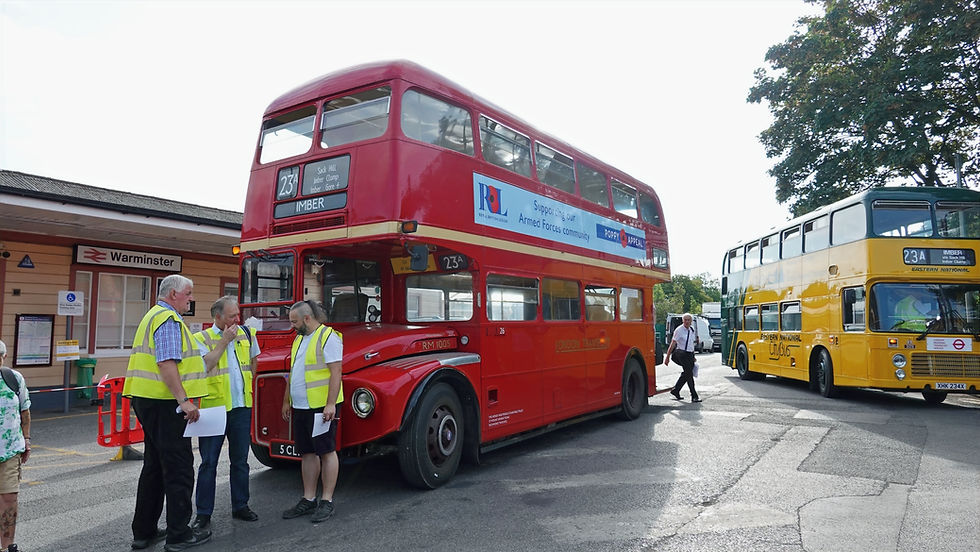
I got the train to Warminster Station and arrived just after 9:00. The first bus was due to depart for Imber at 9:30. The queue was already about ¼ mile long and growing. Whilst patiently waiting with everyone else, a collector relieved me of £10 cash and handed me my rover ticket for the day along with a free event guide. Amongst other things, the guide carried a full page warning by the MOD of the things I should and shouldn't do on my visit.


The first bus set off on time and the queue started moving. Due to the large number of people, it was luck of the draw which bus I was told to get on. As it turned out, I ended up on a current 2026 red TFL electric bus – at least it had air con! I was hoping that on the way back I could choose something a little older with more character - ideally a Routemaster of course! The organisers were hoping for about 40 buses to take part this year.

We stopped at ‘Checkpoint Charlie’ at the top of Sack Hill in Warminster and took on board a few more people who’d parked their cars there and were waiting at a bus stand featuring the London Transport roundel. The bus then drove into the training area across Salisbury Plain. It was a bit like being in a safari park but instead of animals we were looking for old tanks used for target practice!

As I’d walked a fair amount of IRPP earlier in the year, I already knew the landscape to expect, which was really beautiful. It’s a shame we’re not allowed to walk within it.
When we arrived at Imber, the attention to detail by the organisers was clear to see. The bus stops and timetable on them were authentic in every detail. They even had an authentic wooden bus shelter. Things like this are important for nerds!

The highlight of the village was St Giles Church, which was heaving with people inside, who were not only viewing the architecture and reading the information panels but also buying refreshments. In 2005 this Grade I listed building from the 14th century was vested in The Churches Conservation Trust for preservation and repair. With assistance from the MOD, the Trust has carried out a comprehensive campaign of repair and conservation to the building and its wall paintings.


The information panels in the church made for some fascinating and sad reading.


People who were born and lived in Imber before the MOD took over, retained the right to be buried in the churchyard. The last and probably final burial took place in 2023.

Apart from the church, we were allowed to wander up and down the main street, albeit not very far in either direction. The remaining original buildings include the remains of Imber Court, Nag's Head Cottages, the Bell Inn, Seagram's Farm and 2 blocks of terrace council houses that had been built in 1938, 5 years before the village was evacuated.


The ‘houses’ built by the MOD in the 1970s to represent a Northern Ireland street dominate the main street of the village.


Having exhausted Imber village and taking into account how hot it was today, plus seeing the very long queues at the bus stops to go on beyond Imber, I decided I’d go back to Warminster; after all, my earlier walks on the Wessex Ridgeway had taken me to places like New Zealand Farm Camp and West Lavington so I knew what to expect.

I located the bus stop for Warminster and waited for an open-top bus with spaces on top to turn up. There were certainly plenty of bus companies represented.
When one turned up I wasn’t too fussed that it wasn’t an old London Transport Routemaster because I would still have another opportunity to come. I managed to get a seat on top and the drive back to Checkpoint Charlie felt even more like a safari in a game reserve, seeking out more tanks!

At Checkpoint Charlie (Sack Hill Warminster) I got off and carried on down the road in the direction of Warminster town centre. I’d walked along this road in April for my Heytesbury to Bratton Camp stage of the Wessex Ridgeway, so I knew a 200 yard walk from here led to a footpath on to Battlesbury Hill and Battlesbury Camp hillfort at the top of it. On a gorgeous day I wasn’t going to pass up the opportunity of revisiting it – I’d even brough my drone with me.
The buildings you can see are army barracks called Waterloo Lines.

Even from the top of the hill I could see buses going backwards and forwards to Imber.

Having got all the photos & videos I wanted, I walked back to Checkpoint Charlie at the top of Sack Hill. I let a couple of buses go past before a shiny red RML Routemaster turned up to take me back to the station. The ‘RML’ Routemaster was a high capacity version of the original Routemaster. This one was RML 2735 from 1967/68. It is owned by Lord Hendy of Richmond Hill, who is a driving force behind the Imberbus project. The attention to detail on this bus is unbelievable, taking me back to pre-decimal currency days when I lived near Harrow and loved going up to London whenever I could. I admit I was both a train and bus spotter at that time!! The conductor even had an original, working ticket machine and ran a ticket off for me.

Back at Warminster Station, I was expecting the queue to have gone down but it was still snaking around the corner – just a little shorter than it was at 9:00.


What an enjoyable and fascinating experience this had been! I can fully understand why it is so popular. I hope the day raised a lot of money to distribute to the organisers’ charities which include the Friends of St Giles’s Church Imber and the Royal British Legion Poppy Day Appeal.
I think I'll have to repeat Imberbus Day in 2027 but with a new strategy. In hindsight it would have been good to travel by bus beyond Imber to one or more of the outlying villages. Next time I'll get the bus to these villages first and finish with Imber itself. Hopefully this revised strategy will result in less queuing.

Comments